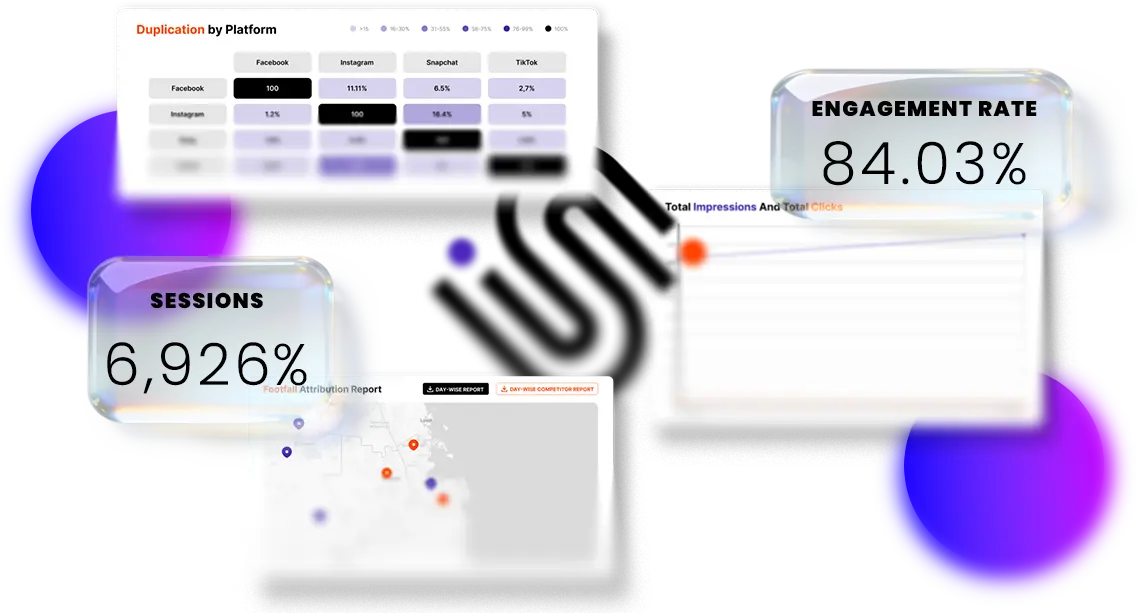
Stretch is a proprietary SaaS platform that sheds light on duplication, cross-platform performance, and real-world impact.

Offline Footfall Attribution
Stretch tag tracks who saw or clicked your ads across channels, and matches that exposure to real-world location visits.
Audience Enrichment & Retargeting
MEmob enriches matched audiences using MEmob+’s 3B real-world data touchpoints; adding behavioral signals, app usage, brand affinity, demographics, and interests that platforms don’t expose while capturing converters and enabling cross-platform reactivation.
Cross-Channel Audience
Duplication Measurement
Stretch tag identifies overlapping audiences in real time, helping advertisers uncover duplication and redirect budgets for maximum real, unique reach.
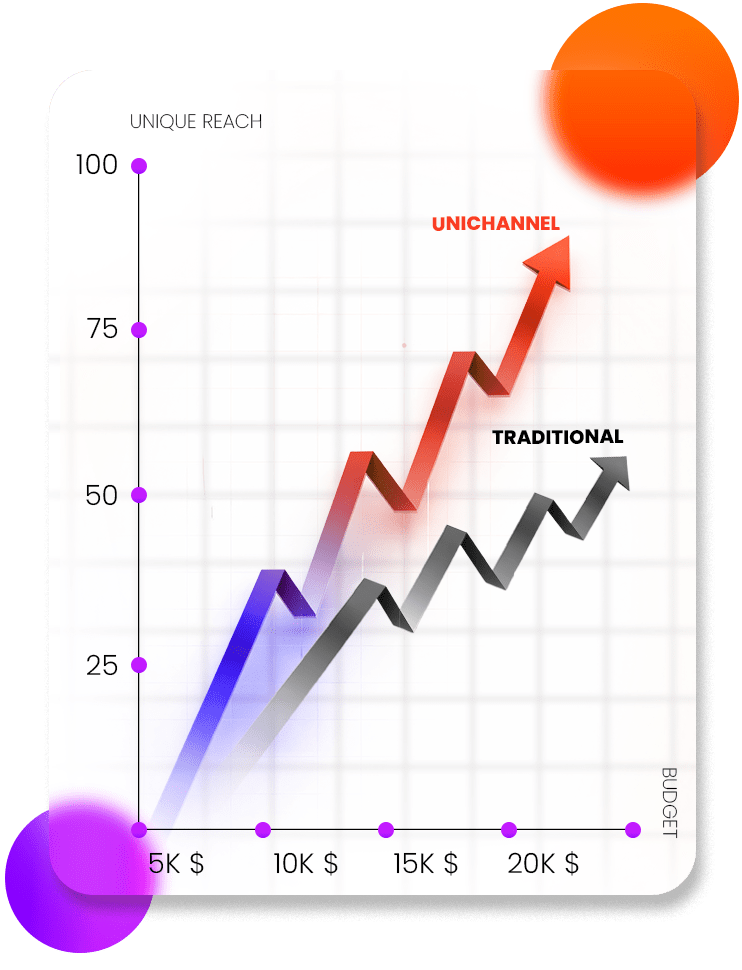
STRETCH unifies the frequency of ad delivery across multiple channels like Meta, TikTok, Snapchat, and other demand-side platforms

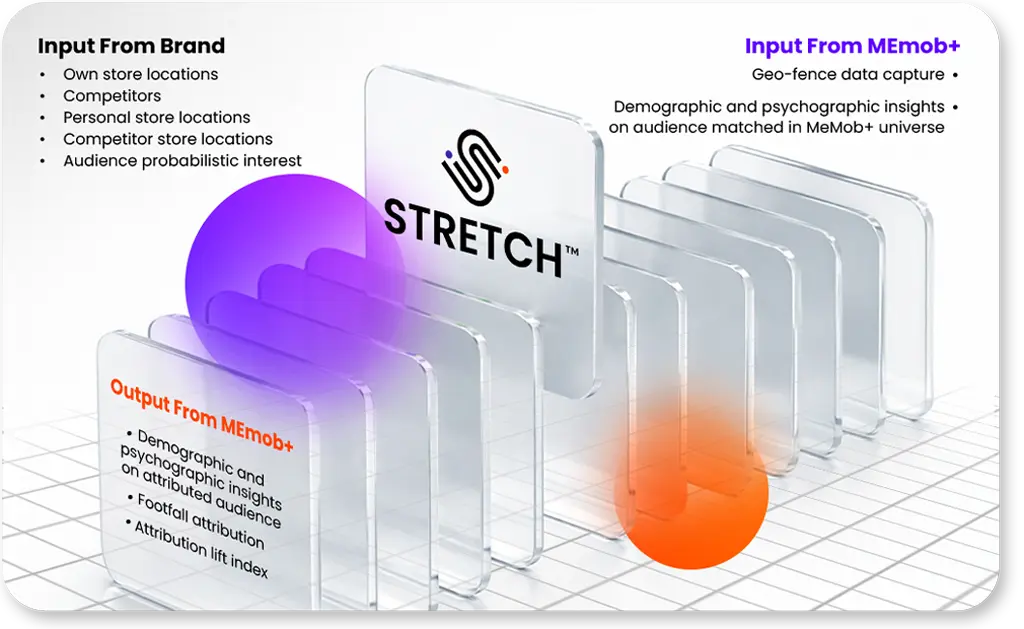
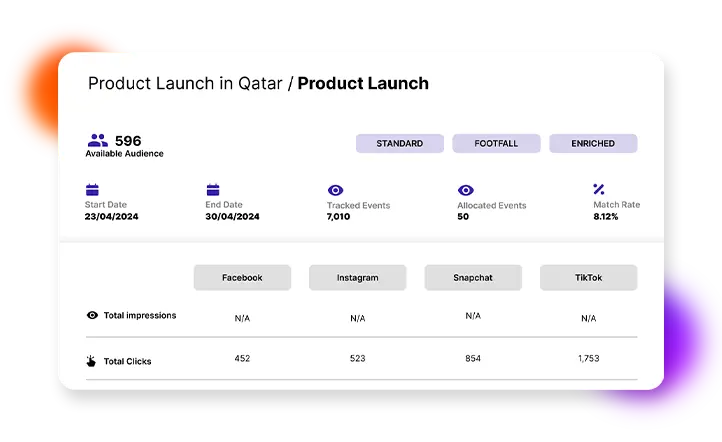
 In-depth reports on the audience targeted across these channels, including demographic information like:
- Age
- Gender, nationality
- Location of work and home
- Psychographics
- Technographics
- Interests, behavior, and more
No SDKs
No Integrations
Just Clarity
Integrating offline attribution methods with your digital marketing initiatives can help you identify potential areas for growth and drive sales to new heights.
Generate ROI by eliminating spillover on null audiences and focusing on delivering the right message, at the right place and time to high value consumers.


Stretch Knowledge Centre
Frequently Asked Questions About Cross-Channel Attribution, Audience Intelligence & Offline Measurement.
Stretch is MEmob+’s cross-channel marketing intelligence and attribution platform designed to solve one of the biggest challenges facing modern marketers: understanding how customers interact with advertising across multiple digital channels before taking a real-world action.
Today’s consumers rarely interact with a single advertisement before making a purchase or visiting a physical location. A customer may first discover a brand through a video campaign on YouTube, later engage with a display advertisement served through DV360, click a sponsored post on Instagram, receive a retargeting advertisement on Meta, and finally visit a physical retail store several days later. Each advertising platform measures only the interactions occurring within its own ecosystem, creating fragmented reporting that makes it difficult to understand the complete customer journey.
Stretch was built specifically to eliminate these silos by providing a unified measurement framework that connects advertising exposure, audience behaviour and real-world business outcomes across multiple marketing channels.
Unlike traditional reporting dashboards that analyse performance platform by platform, Stretch consolidates campaign intelligence into a single environment where marketers can understand how their complete media strategy contributes to customer acquisition, engagement, conversions and offline visits.
At its core, Stretch performs five critical functions that enable organisations to improve marketing performance.
The first is Cross-Channel Attribution. Stretch combines campaign exposure across multiple advertising platforms to build a more complete understanding of how users progress through the marketing funnel. Rather than evaluating Meta Ads, Google Ads, TikTok or Display campaigns independently, marketers can analyse how different channels contribute collectively to business objectives.
The second capability is Audience Deduplication. One of the most common inefficiencies in digital advertising is paying multiple times to reach the same individual across different advertising platforms. Stretch identifies overlapping audiences across campaigns, allowing advertisers to understand audience duplication and optimise media investment by reducing unnecessary frequency.
The third capability is Offline Attribution. Digital campaigns increasingly aim to influence real-world behaviour such as store visits, dealership appointments, shopping mall traffic, tourism activity or branch visits. Stretch connects digital advertising exposure with verified offline visitation, allowing organisations to understand whether advertising investment generated measurable physical outcomes rather than relying solely on clicks or online conversions.
The fourth capability is Audience Enrichment. Stretch enhances first-party and campaign audiences with additional behavioural, geographic and lifestyle intelligence. Rather than analysing anonymous impressions, organisations gain a richer understanding of who their audiences are, where they spend time, how they move between locations and which interests influence purchasing decisions. This enables significantly more precise campaign planning and audience segmentation.
The fifth capability is Cross-Platform Audience Activation. Insights generated within Stretch are not limited to reporting. Audience intelligence can be activated across multiple advertising platforms, enabling marketers to create refined audience segments, suppress existing customers, retarget high-value visitors, reach lookalike audiences and optimise future campaigns based on verified behavioural intelligence.
Stretch also addresses one of the biggest limitations of platform-native attribution models. Every advertising platform naturally attributes success within its own ecosystem. Meta evaluates Meta campaigns, Google evaluates Google campaigns and TikTok measures TikTok interactions. This often creates competing performance reports and inconsistent attribution windows that make strategic decision-making extremely difficult for marketing teams.
Stretch provides an independent layer of measurement that allows organisations to evaluate marketing performance holistically rather than relying on isolated platform reports. Decision makers gain a clearer understanding of incremental reach, audience overlap, cross-platform contribution and the actual impact of marketing investment on business outcomes.
For enterprise organisations managing complex advertising strategies across multiple markets, this independent measurement becomes increasingly valuable. Retailers can understand which media channels generate verified store visits. Automotive brands can measure dealership traffic driven by digital campaigns. Financial institutions can analyse branch visitation after awareness campaigns. Tourism authorities can evaluate destination visitation following multi-channel promotional initiatives. Real estate developers can assess which advertising channels generate qualified project visits.
Privacy is another fundamental component of Stretch. The platform is designed around privacy-first marketing principles and analyses aggregated audience intelligence rather than exposing personally identifiable information. This enables organisations to improve campaign effectiveness while supporting responsible data practices and evolving privacy regulations.
Because Stretch integrates measurement, audience intelligence, offline attribution and activation into a single workflow, marketing teams spend less time reconciling reports from multiple platforms and more time making informed optimisation decisions. Instead of asking which platform generated the most impressions or clicks, organisations can focus on the questions that matter most: Which marketing investment generated incremental business value? Which audiences converted most efficiently? Which channels contributed to real customer behaviour? And where should future budgets be allocated to maximise return on investment?
Ultimately, Stretch transforms fragmented advertising data into actionable marketing intelligence. By combining cross-channel attribution, audience enrichment, offline measurement and activation capabilities within a unified platform, it enables organisations to understand not just where advertising was delivered, but how advertising influences consumer behaviour across the entire customer journey from first exposure to measurable business outcomes.
One of the biggest hidden costs in digital advertising is audience duplication. Most organisations invest in multiple advertising platforms simultaneously such as Meta, Google DV360, YouTube, TikTok, Snapchat, LinkedIn and programmatic display but very few understand how many of the same people are being reached repeatedly across these channels. Stretch was developed specifically to solve this challenge by providing cross-channel audience intelligence that identifies overlap, measures duplication and enables marketers to optimise campaign efficiency.
Every advertising platform operates within its own ecosystem. Meta reports impressions, reach and frequency only for Meta campaigns. TikTok measures engagement only within TikTok. Google DV360 analyses programmatic delivery independently from Meta or Snapchat. As a result, each platform may report excellent reach figures, yet a significant proportion of those impressions may have been delivered to the same users across multiple channels.
For example, a retail brand running simultaneous campaigns on Meta, TikTok and Google Display might believe it has reached three million unique users because each platform reports one million people reached. In reality, there may only be 1.6 million unique individuals, with hundreds of thousands of users exposed to advertisements across two or even all three platforms. Without independent measurement, these overlaps remain invisible, making campaign reach appear much larger than it actually is.
Stretch addresses this problem by providing a unified measurement layer that analyses campaign exposure across multiple advertising ecosystems. Rather than treating each platform as a separate reporting environment, Stretch evaluates audience relationships across campaigns to identify where duplication exists, where incremental reach is achieved and where media investment can be optimised.
This process is known as Cross-Channel Audience Matching.
Cross-Channel Audience Matching allows marketers to understand how audiences interact with advertising regardless of where impressions were delivered. Instead of asking how many people were reached on Meta or TikTok individually, organisations can answer more strategic questions such as:
- How many unique people saw our campaigns across every advertising platform?
- Which advertising platforms are reaching entirely new audiences?
- Which platforms are repeatedly serving impressions to the same users?
- How much media budget is being spent on duplicated reach?
- Which audience segments are experiencing excessive advertising frequency?
- Where can campaign budgets be reallocated to maximise incremental reach?
Stretch visualises these relationships by analysing audience overlap between campaigns. Marketing teams can compare multiple advertising channels simultaneously and understand how audiences intersect across their entire media ecosystem. This provides a much clearer picture of true campaign reach than relying solely on platform-specific reporting.
Reducing audience duplication has significant commercial value. Every duplicated impression represents budget that could potentially have reached a new customer. By identifying overlapping audiences, marketers can improve media efficiency without necessarily increasing advertising spend. Campaign budgets can instead be redirected towards incremental audience acquisition, expanding total market coverage while maintaining optimal frequency.
Stretch also supports frequency management. Consumers often receive excessive numbers of impressions when brands advertise across multiple platforms simultaneously. While each platform may individually respect frequency limits, no individual platform understands how many advertisements a user has already seen elsewhere.
This creates situations where consumers receive repeated exposure across multiple digital channels, leading to advertising fatigue, declining engagement rates and diminishing returns. Stretch enables organisations to evaluate cumulative exposure across campaigns, helping marketing teams maintain healthier frequency distribution while improving customer experience.
Audience duplication analysis becomes particularly valuable for enterprise organisations operating across multiple brands, agencies or regional markets. It is common for separate campaign teams to unknowingly target highly similar audiences through different media buying strategies. Stretch provides centralised visibility across campaigns, allowing organisations to coordinate audience strategies and eliminate unnecessary overlap between business units.
Another important capability is identifying incremental reach. Not every advertising platform contributes equally to customer acquisition. Some channels may primarily reinforce existing exposure, while others introduce brands to completely new audiences. Stretch helps organisations distinguish between reinforcement and expansion by measuring how much new audience each platform contributes relative to existing campaigns.
For example, a tourism authority promoting an international destination may discover that Meta and Instagram campaigns generate significant audience overlap, while Connected TV or premium programmatic display introduces a much larger proportion of previously unreached travellers. These insights enable more informed media planning decisions and support more balanced channel allocation.
Stretch also integrates audience intelligence with behavioural insights. Instead of simply identifying duplicated users, organisations can understand whether overlapping audiences exhibit different behaviours, interests, geographic movement patterns or purchase intent. This allows advertisers to prioritise high-value audience segments while reducing waste among less valuable overlapping groups.
Importantly, Stretch performs this analysis using privacy-first methodologies. The platform is designed to analyse aggregated audience relationships rather than exposing personally identifiable information. Organisations receive meaningful marketing intelligence without compromising consumer privacy, supporting responsible advertising practices and compliance with evolving privacy regulations.
Audience duplication intelligence also improves downstream marketing activities such as audience enrichment, suppression strategies, lookalike modelling and retargeting. Existing customers can be excluded more accurately, high-value audience segments can be prioritised and future campaigns can be built on verified behavioural intelligence rather than isolated platform data.
For organisations managing substantial advertising investment, these capabilities translate directly into measurable business value. Retailers reduce wasted impressions and improve store visitation efficiency. Automotive manufacturers optimise dealership acquisition campaigns. Financial institutions improve branch acquisition strategies. Tourism organisations maximise destination awareness while controlling advertising costs. Real estate developers refine audience targeting for new project launches.
Ultimately, Stretch transforms audience duplication from an invisible marketing inefficiency into actionable business intelligence. By identifying overlap across Meta, TikTok, Google DV360, Snapchat, programmatic advertising and other digital ecosystems, Stretch enables marketers to understand true campaign reach, optimise media investment, reduce unnecessary advertising frequency and build more efficient cross-channel marketing strategies that maximise both audience growth and return on investment.
Cross-Channel Audience Matching is the process of identifying, measuring and understanding how the same audience interacts with advertising campaigns across multiple digital platforms. It enables marketers to determine whether different advertising channels are reaching unique consumers or repeatedly serving advertisements to the same people. Stretch was built around this capability because one of the largest inefficiencies in modern digital advertising is not poor creative or poor targeting it is the inability to understand audience overlap across fragmented media ecosystems.
Today, most enterprise advertisers invest across several advertising platforms simultaneously. A single campaign may run on Meta, TikTok, Google DV360, YouTube, Snapchat, Connected TV and premium programmatic inventory at the same time. Every platform reports its own impressions, reach, clicks and conversions independently, giving marketers valuable insights into individual channel performance. However, none of these platforms provide a complete view of how audiences overlap with one another.
This creates a significant blind spot.
For example, a brand may believe it has reached five million consumers because each advertising platform reports strong reach numbers independently. In reality, a substantial proportion of those users may have seen the campaign across multiple channels. Without understanding this duplication, marketers often overestimate campaign reach while simultaneously increasing advertising frequency and media costs.
Stretch solves this challenge through Cross-Channel Audience Matching, one of its core platform capabilities. Instead of analysing advertising platforms individually, Stretch creates a unified measurement layer that evaluates audience interactions across the complete media ecosystem. This enables organisations to understand not just how campaigns performed within each platform, but how every channel contributes to the overall customer journey.
The process begins with the Stretch Tag. Unlike many attribution platforms that require software development kits (SDKs), complex integrations or changes to existing applications, Stretch uses a lightweight tag that is embedded directly into advertising creatives across supported social and programmatic channels. As campaigns run, the tag collects campaign interaction signals including impressions and clicks across multiple advertising environments. These events are analysed in real time before being consolidated into a single reporting framework.
Once campaign events have been collected, Stretch analyses audience relationships across every participating platform. Rather than treating Meta, TikTok, Google DV360 or Snapchat as isolated ecosystems, the platform identifies where audiences intersect and calculates the degree of duplication between campaigns.
This enables marketers to answer questions that traditional advertising dashboards cannot answer, including:
- How many unique individuals were reached across every campaign?
- Which advertising platforms contributed genuinely new audiences?
- Which platforms repeatedly reached the same consumers?
- Where is advertising frequency unnecessarily high?
- Which channels deliver the strongest incremental reach?
- Which audiences should be suppressed to reduce wasted impressions?
These insights fundamentally change how media planning decisions are made.
One of the most important outcomes of Cross-Channel Audience Matching is incremental reach analysis. Every advertising platform contributes differently to campaign objectives. Some platforms primarily reinforce awareness among existing audiences, while others introduce brands to completely new consumers. Stretch enables marketers to distinguish between these two roles by identifying which channels expand audience reach and which simply duplicate existing exposure.
This insight has a direct impact on marketing return on investment.
Rather than increasing advertising budgets to achieve greater reach, organisations can optimise existing investment by reallocating spend toward channels that introduce new audiences. Even relatively small reductions in audience duplication can significantly improve media efficiency because every duplicated impression represents budget that could have reached a potential new customer.
Cross-Channel Audience Matching also improves frequency management.
Frequency is one of the most overlooked variables in digital advertising. Every advertising platform manages its own frequency caps independently, but none of them understand how many advertisements an individual has already seen elsewhere. As a result, consumers may receive excessive exposure across multiple platforms without advertisers realising it.
Stretch provides marketers with a consolidated view of cumulative audience exposure. This enables campaign managers to identify overexposed audience segments, adjust media allocation and improve customer experience by preventing unnecessary advertising repetition.
Another major advantage of Stretch is its ability to transform matched audiences into future marketing opportunities.
Once audience relationships have been identified, Stretch enables organisations to activate those insights strategically. Marketing teams can create suppression audiences to eliminate existing customers from acquisition campaigns, build high-value retargeting audiences based on verified engagement, develop lookalike audiences from the most valuable customer groups and activate enriched audiences across multiple advertising platforms. Instead of simply reporting duplication, Stretch converts audience intelligence into actionable campaign optimisation.
Cross-Channel Audience Matching also enhances campaign reporting for enterprise organisations operating across multiple agencies, brands or geographic markets. Large organisations often execute numerous campaigns simultaneously, making it difficult to understand how audience overlap occurs between different business units. Stretch centralises audience intelligence within a single dashboard, allowing marketing leaders to coordinate campaigns more effectively while reducing internal competition for the same consumers.
Importantly, this entire process operates within a privacy-first framework. Stretch analyses aggregated audience relationships and behavioural intelligence rather than exposing personally identifiable information. Organisations gain comprehensive cross-channel insights while supporting responsible data practices and maintaining compliance with evolving privacy expectations.
For retailers, this means acquiring more unique shoppers with the same advertising budget. Automotive brands can identify which media channels generate genuinely incremental dealership visitors. Tourism authorities can maximise destination awareness among previously unreached travellers. Financial institutions can optimise branch acquisition campaigns by reducing duplicated exposure. Consumer brands can improve omnichannel media efficiency while lowering wasted advertising spend.
Ultimately, Cross-Channel Audience Matching is not simply a reporting feature it is the foundation of modern omnichannel marketing measurement. By identifying audience duplication, measuring incremental reach, optimising advertising frequency and enabling cross-platform audience activation, Stretch gives organisations an accurate understanding of how their complete media ecosystem performs. This enables marketers to make smarter investment decisions, improve campaign efficiency and maximise marketing ROI through a unified, data-driven approach to audience intelligence.
One of the biggest challenges in digital advertising is proving whether online campaigns generate real-world business outcomes. While advertising platforms can accurately report impressions, clicks, video views and online conversions, they rarely answer the question that matters most to many organisations:
Did our advertising actually bring customers into our stores, dealerships, restaurants, branches or physical locations?
Stretch was developed specifically to answer this question through Offline Attribution a capability that connects digital advertising exposure with verified physical visitation. Instead of measuring success solely through digital engagement metrics, Stretch enables organisations to understand how advertising influences consumer behaviour beyond the screen, providing a measurable link between media investment and real-world business performance.
Traditional attribution models typically end when a user clicks an advertisement or completes an online action. However, for many industries, the most valuable conversion does not occur online. Retailers measure success through store purchases. Automotive manufacturers value dealership visits. Banks depend on branch appointments. Tourism organisations aim to increase visitor numbers. Restaurants seek additional footfall. Real estate developers want project visits.
Without offline attribution, marketers often optimise campaigns using incomplete data.
Stretch closes this measurement gap by connecting advertising events with subsequent offline behaviour. Using the Stretch Tag, the platform captures campaign interactions across supported advertising channels, including impressions and clicks, before analysing how those interactions relate to real-world location visits. Instead of relying on assumptions, marketers receive evidence-based insights into whether advertising exposure contributed to measurable business outcomes.
The process begins when organisations deploy a Stretch Tag across their campaign creatives. Unlike attribution platforms that require software development kits (SDKs), application modifications or extensive technical integrations, Stretch uses a lightweight implementation that works across social and programmatic advertising campaigns. As advertisements are delivered, the Stretch Tag records campaign interaction events in real time while consolidating them into a unified reporting environment.
Once advertising exposure has been measured, Stretch analyses anonymised mobility intelligence to determine whether members of the exposed audience subsequently visited predefined Points of Interest such as retail stores, dealerships, restaurants, shopping centres, hotels, event venues or other business locations. This creates a measurable relationship between advertising activity and physical visitation without relying solely on online conversions.
For example, a retailer launching a national awareness campaign across Meta, TikTok and Google DV360 can use Stretch to understand not only how many users clicked on advertisements but also how many members of the exposed audience subsequently visited physical stores. Instead of optimising campaigns based purely on digital engagement metrics, marketers can evaluate advertising using business outcomes that directly influence revenue.
Stretch also enables organisations to compare exposed audiences with verified visitors, helping marketers understand how digital advertising contributes to customer acquisition. Campaigns can be evaluated based on attributed footfall, allowing businesses to calculate metrics such as:
- Cost per store visit
- Campaign-driven footfall
- Incremental visitation
- Conversion from ad exposure to physical visit
- Visit rates across advertising platforms
- Store visitation by campaign
- Location performance following media investment
These metrics provide significantly more meaningful insight than impressions or clicks alone because they reflect actual consumer behaviour.
Offline Attribution becomes particularly valuable when organisations operate multiple advertising channels simultaneously. A customer may first discover a product through TikTok, later interact with a Meta advertisement, receive additional exposure through programmatic display and ultimately visit a physical store several days later. Platform-native reporting rarely provides visibility across this complete customer journey.
Stretch consolidates these interactions into one measurement framework, allowing marketers to understand how multiple advertising touchpoints contribute collectively to offline outcomes. This supports better media planning while helping organisations identify which channels generate the strongest real-world impact rather than simply the highest click-through rates.
Another important capability is competitor visitation analysis. Businesses can compare audiences visiting their own locations against those visiting competitor locations, helping marketers understand customer switching behaviour and evaluate whether advertising campaigns influence market share. Retailers can measure whether competitor shoppers subsequently visit their own stores. Automotive manufacturers can identify dealership switching. Restaurant chains can analyse movement between competing brands. These insights extend attribution beyond basic campaign reporting into strategic market intelligence.
Offline Attribution also improves budget optimisation. Marketing teams often allocate spending according to platform-reported conversions without understanding which campaigns actually influence physical customer behaviour. Stretch enables organisations to redirect investment toward channels generating verified offline visits rather than relying exclusively on digital engagement metrics. This allows budgets to be optimised using measurable commercial outcomes rather than isolated platform reports.
Privacy remains fundamental throughout the attribution process. Stretch does not identify individual consumers or expose personally identifiable information. Instead, the platform analyses aggregated and anonymised mobility intelligence to establish relationships between advertising exposure and location visitation while supporting responsible data practices and evolving privacy regulations.
Offline Attribution provides measurable value across numerous industries.
Retailers can determine which campaigns increase in-store traffic.
Automotive brands can measure dealership visits following vehicle launches.
Banks can analyse branch acquisition campaigns.
Hospitality groups can evaluate hotel visitation.
Tourism authorities can assess destination marketing initiatives.
Real estate developers can measure project visits generated by advertising.
Entertainment venues can evaluate attendance driven by digital campaigns.
In every case, Stretch shifts campaign evaluation away from proxy metrics and toward measurable business performance.
Ultimately, Offline Attribution transforms digital advertising from an activity measured primarily by impressions and clicks into one evaluated through real-world customer behaviour. By connecting campaign exposure with verified location visits, Stretch enables organisations to understand how advertising influences physical actions, optimise investment based on actual business outcomes and demonstrate marketing value with greater confidence. For organisations seeking true accountability across omnichannel marketing, Offline Attribution represents one of the most important capabilities within the Stretch platform.
Every advertising platform provides campaign reporting, but none provides a complete understanding of the people behind the results. Meta Ads Manager reports impressions, clicks and conversions within the Meta ecosystem. Google DV360 focuses on programmatic delivery and engagement. TikTok Ads Manager reports video interactions and campaign performance. While these insights are valuable, they remain limited to the data collected within each individual platform.
Stretch was developed to solve this limitation by transforming campaign interactions into rich, actionable audience intelligence. Rather than simply reporting how many people clicked on an advertisement, Stretch helps organisations understand who those audiences are, how they behave in the real world, what brands they engage with, which applications they use, where they travel, what interests they demonstrate and how they move throughout the customer journey.
This capability is known as Audience Enrichment, and it represents one of Stretch’s most powerful differentiators.
Most advertising platforms treat users as anonymous campaign metrics. A marketer may know that an advertisement generated 10,000 clicks or reached one million people, but very little is revealed about the quality of those audiences beyond standard demographic categories such as age, gender or location.
Stretch goes significantly further.
After analysing campaign interactions through the Stretch Tag, the platform matches eligible audiences against the MEmob+ Data Lake, allowing organisations to enrich campaign audiences with a much broader understanding of real-world consumer behaviour. Instead of analysing isolated advertising events, businesses gain access to a multidimensional audience profile built from behavioural intelligence rather than platform-specific reporting. This audience enrichment capability is a core feature of Stretch and enables organisations to extend campaign insights with behavioural attributes that most advertising platforms do not provide.
Depending on campaign objectives and available data, enriched audience profiles can include insights such as:
- Real-world mobility behaviour
- Brand affinity
- Shopping behaviour
- Interest categories
- Demographic characteristics
- Lifestyle indicators
- App usage patterns
- Geographic movement
- Visitation behaviour
- Audience engagement patterns
These insights enable marketers to move beyond surface-level campaign reporting and begin understanding why specific audiences respond to advertising.
For example, an automotive manufacturer may discover that audiences engaging with SUV campaigns also demonstrate strong affinity for outdoor brands, luxury retail destinations and family-focused shopping centres. A retail brand may identify that high-performing campaign audiences regularly visit premium malls, travel internationally several times per year and actively engage with lifestyle applications. A tourism authority may discover that destination campaigns resonate particularly well with audiences who frequently visit airports, luxury hotels and entertainment districts.
Without Audience Enrichment, these behavioural relationships remain invisible.
Stretch transforms campaign exposure into meaningful audience intelligence that supports future marketing decisions.
One of the greatest advantages of Audience Enrichment is its ability to improve future campaign planning.
Traditional optimisation focuses primarily on historical performance metrics such as click-through rates, cost per click or conversion rates. Stretch enables organisations to optimise campaigns based on audience quality rather than campaign performance alone.
Marketing teams can identify which audience characteristics consistently produce stronger business outcomes and use those insights to refine future targeting strategies. Instead of simply targeting broad demographic groups, campaigns can focus on audiences exhibiting verified behavioural patterns associated with higher purchase intent.
Audience Enrichment also supports more effective customer segmentation.
Not every campaign audience behaves the same way. Stretch enables organisations to identify distinct audience groups according to behavioural characteristics rather than relying exclusively on age or gender. These enriched audience segments become significantly more valuable for campaign personalisation, media planning and lifecycle marketing.
Another major benefit is improving cross-platform activation.
Once audiences have been enriched, organisations can activate those insights across multiple advertising environments. High-value audience segments can be retargeted, lookalike audiences can be developed from the strongest-performing customer groups and suppression audiences can be created to reduce wasted media investment.
Rather than rebuilding audiences independently inside each advertising platform, marketers can use a single enriched understanding of customer behaviour to inform campaigns across Meta, TikTok, Google DV360, Snapchat and other supported media channels.
Audience Enrichment also plays a critical role in improving marketing attribution.
Understanding which campaigns generated engagement is useful.
Understanding who engaged, why they engaged and what they did afterwards is considerably more valuable.
By combining behavioural intelligence with campaign measurement, Stretch helps organisations understand the characteristics of audiences most likely to visit stores, convert into customers or engage with future campaigns. This transforms attribution reporting into actionable marketing intelligence.
Privacy remains central throughout the enrichment process.
Stretch does not expose personally identifiable information or reveal individual consumer identities. Audience Enrichment is performed using aggregated, anonymised and privacy-first methodologies that provide meaningful business intelligence while supporting responsible data practices and evolving privacy regulations.
The result is a richer understanding of audiences without compromising consumer trust.
Audience Enrichment creates measurable value across numerous industries.
Retailers can identify the behavioural characteristics of their highest-value shoppers.
Automotive brands can understand the lifestyle indicators associated with prospective vehicle buyers.
Banks can analyse audiences engaging with financial campaigns.
Tourism authorities can better understand destination visitors.
Real estate developers can identify audiences most likely to visit new projects.
Consumer brands can refine acquisition campaigns using verified behavioural intelligence rather than inferred interests alone.
Ultimately, Audience Enrichment transforms campaign reporting into customer intelligence.
Rather than stopping at impressions, clicks or conversions, Stretch helps organisations understand the people behind those metrics. By enriching campaign audiences with behavioural, mobility, demographic and lifestyle insights derived from the MEmob+ Data Lake, Stretch enables marketers to build smarter audience strategies, improve campaign personalisation, optimise cross-platform activation and make better marketing decisions based on how consumers actually behave not simply how they interact with advertisements.
One of the biggest challenges facing modern marketing teams is maintaining consistent audience strategies across multiple advertising platforms. Businesses often build audiences separately inside Meta Ads Manager, Google DV360, TikTok Ads, Snapchat Ads, LinkedIn Campaign Manager and other advertising ecosystems. Each platform has its own audience builder, targeting logic, reporting model and activation process, forcing marketers to recreate similar audience segments repeatedly for every campaign.
This fragmented approach is time-consuming, inconsistent and often leads to different audience definitions across platforms. More importantly, each advertising platform only understands the interactions that occur within its own ecosystem. As a result, valuable customer intelligence generated from one campaign rarely benefits campaigns running elsewhere.
Stretch was designed to eliminate this fragmentation through Cross-Platform Audience Activation a capability that allows organisations to transform unified audience intelligence into actionable marketing audiences that can be activated across multiple digital advertising environments. Instead of rebuilding audiences independently for every platform, Stretch creates a central layer of audience intelligence that supports more consistent, efficient and data-driven activation strategies.
The process begins with campaign measurement.
Using the Stretch Tag, organisations collect campaign interactions across supported advertising platforms. These interactions include impressions, clicks and engagement signals generated from social, programmatic and display advertising. Rather than storing these events inside isolated platform reports, Stretch consolidates campaign intelligence into a single environment where audience behaviour can be analysed holistically.
Once campaigns have been measured, Stretch applies Cross-Channel Audience Matching, Audience Enrichment and Offline Attribution to create a significantly deeper understanding of every audience segment. Instead of working with isolated campaign metrics, marketers now have access to enriched audiences built around behavioural intelligence, mobility insights, brand affinity, demographic characteristics and verified engagement.
This unified audience intelligence becomes the foundation for future campaign activation.
One of the primary activation use cases is Audience Retargeting.
Traditional retargeting generally depends on website visitors, pixel events or platform-specific engagement. Stretch expands this capability by allowing organisations to create richer audience segments based on verified interactions across multiple campaigns and channels. Rather than simply retargeting users who clicked on a single advertisement, businesses can develop audiences based on cumulative engagement, behavioural characteristics and cross-channel interactions.
For example, a retailer launching a seasonal campaign may wish to re-engage consumers who viewed multiple advertisements across Meta and TikTok but did not visit a physical store. Instead of creating separate retargeting audiences inside each advertising platform, Stretch enables marketers to identify these audiences centrally before activating refined audience segments across supported media channels.
Another major capability is Audience Suppression.
Advertising budgets are frequently wasted serving acquisition campaigns to existing customers or recently converted users. Because advertising platforms operate independently, suppression lists often remain incomplete or inconsistent between campaigns.
Stretch helps organisations create more intelligent suppression strategies by identifying existing customers, recent converters or previously engaged audiences before campaigns are activated. This prevents unnecessary advertising spend while improving campaign efficiency and customer experience.
Cross-platform activation also supports Lookalike Audience Development.
Rather than generating lookalike audiences from basic customer lists, Stretch enables organisations to build high-quality seed audiences based on verified behavioural intelligence. Businesses can identify their most valuable customers using campaign engagement, offline visitation, audience enrichment and mobility analysis before creating expanded prospecting audiences for future acquisition campaigns.
This results in stronger audience quality and more accurate prospecting than relying exclusively on platform-native audience models.
Another important advantage is campaign consistency.
Large enterprise organisations often operate multiple advertising agencies, regional marketing teams and business units simultaneously. Without a centralised audience intelligence platform, each team may create slightly different audience definitions for similar campaigns, resulting in inconsistent targeting and fragmented customer experiences.
Stretch provides a unified audience framework that allows organisations to standardise audience strategies across markets and advertising platforms. Marketing teams can activate consistent audience definitions while still adapting creative messaging and media allocation to individual campaign objectives.
Cross-platform activation also enables organisations to maximise the value of their first-party data.
As third-party cookies continue to decline and privacy regulations evolve, businesses increasingly depend on first-party customer relationships. Stretch strengthens these relationships by combining first-party data with audience enrichment and behavioural intelligence, creating more valuable activation audiences without relying solely on third-party identifiers.
This helps organisations future-proof their marketing strategies while supporting privacy-first advertising approaches.
Importantly, Stretch performs audience activation without exposing personally identifiable information. The platform has been designed around aggregated, privacy-compliant audience intelligence that enables organisations to activate meaningful audience segments while maintaining responsible data governance and regulatory compliance.
The commercial impact of Cross-Platform Audience Activation extends across numerous industries.
Retailers can retarget high-intent shoppers who engaged with multiple campaigns but have not yet visited stores.
Automotive manufacturers can activate audiences who researched competitor dealerships before launching new vehicle campaigns.
Banks can suppress existing account holders while focusing acquisition efforts on qualified prospects.
Tourism organisations can re-engage previous destination visitors with personalised travel campaigns.
Real estate developers can activate audiences who demonstrated sustained engagement with project marketing across multiple advertising channels.
Consumer brands can build unified audience strategies that improve customer acquisition while reducing duplicated effort across media platforms.
Ultimately, Cross-Platform Audience Activation transforms audience intelligence into business action.
Rather than rebuilding audiences independently inside every advertising platform, Stretch creates a centralised marketing intelligence layer where campaign measurement, audience enrichment, cross-channel attribution and behavioural insights work together to support more intelligent activation. By enabling organisations to retarget, suppress, expand and activate audiences using a single source of truth, Stretch helps marketers execute more efficient omnichannel campaigns, improve advertising performance and maximise long-term marketing return on investment.
One of the biggest barriers to implementing marketing measurement platforms is technical complexity. Many attribution and customer analytics solutions require businesses to install software development kits (SDKs), modify mobile applications, rebuild websites, integrate multiple APIs, synchronise customer databases or involve development teams for weeks before any data becomes available. These lengthy implementation projects often delay campaign optimisation, increase deployment costs and create ongoing maintenance requirements.
Stretch was designed differently.
From the beginning, Stretch was developed as a lightweight, enterprise-ready marketing intelligence platform that could be implemented quickly without disrupting existing advertising technology stacks. Rather than requiring organisations to replace their current advertising platforms or redesign their digital infrastructure, Stretch works alongside existing marketing ecosystems, allowing businesses to continue using Meta, Google DV360, TikTok, Snapchat, LinkedIn and other advertising platforms exactly as they do today while adding an independent layer of cross-channel measurement and attribution.
At the centre of this architecture is the Stretch Tag.
The Stretch Tag is a lightweight tracking component that is embedded directly into digital advertising creatives. Unlike SDK-based attribution platforms that require integration inside mobile applications or extensive modifications to websites, the Stretch Tag is deployed at the campaign level. Once implemented, it captures advertising interaction events such as impressions and clicks across supported social, display and programmatic advertising channels before securely transmitting those events to the Stretch platform for analysis.
This approach dramatically reduces implementation complexity.
Marketing teams do not need to redesign their websites.
Mobile development teams do not need to release new applications.
Advertising platforms do not need to be replaced.
Existing campaign workflows remain unchanged.
Instead, Stretch integrates naturally into existing media buying processes while adding significantly more measurement capability than individual advertising platforms can provide on their own. This lightweight implementation is one of the core reasons why organisations can deploy Stretch much faster than traditional attribution platforms while continuing to work with their preferred media buying tools. The Stretch Tag captures campaign events centrally, enabling unified reporting without requiring disruptive changes to existing advertising infrastructure.
Another important advantage of this architecture is platform independence.
Every major advertising platform is designed to measure activity occurring within its own ecosystem. Meta reports Meta performance. TikTok reports TikTok campaigns. Google DV360 reports programmatic delivery. These systems rarely communicate with one another, leaving organisations with fragmented reporting and inconsistent attribution.
Stretch does not replace these platforms.
Instead, it operates as an independent intelligence layer positioned above them.
Campaign interaction data from multiple advertising ecosystems is consolidated into one unified reporting environment, allowing marketers to analyse campaign performance, audience behaviour and attribution consistently across every channel without modifying the underlying advertising platforms.
Because Stretch remains independent from individual advertising ecosystems, organisations retain complete flexibility when planning media strategies.
New advertising platforms can be introduced without rebuilding attribution frameworks.
Existing media partners can be replaced without losing historical intelligence.
Campaign strategies can evolve without requiring extensive redevelopment.
This flexibility is particularly valuable for enterprise organisations managing campaigns across multiple agencies, countries or business units.
The lightweight architecture also accelerates time-to-value.
Traditional marketing technology implementations may require months before actionable insights become available.
Stretch enables organisations to begin collecting campaign intelligence shortly after deployment, allowing marketing teams to analyse cross-channel performance, audience overlap, offline attribution and audience enrichment much earlier in the campaign lifecycle. Faster implementation means optimisation decisions can be made while campaigns are still active rather than after budgets have already been spent.
Stretch also reduces ongoing operational complexity.
Many attribution platforms require continuous SDK maintenance whenever operating systems, mobile applications or advertising platforms are updated.
Because Stretch relies on campaign-level implementation rather than application-level integrations, maintenance requirements remain significantly lower. Marketing teams can continue launching campaigns without requiring frequent technical intervention, reducing dependence on software development resources.
Another important benefit is improved scalability.
As organisations expand into new markets, launch additional brands or begin advertising across new channels, Stretch scales with them. New campaigns can be incorporated into the existing measurement framework without rebuilding attribution infrastructure or creating separate reporting environments.
This allows enterprise organisations to maintain one consistent measurement methodology across their entire marketing operation.
Stretch’s architecture also supports privacy-first measurement.
The platform has been designed to analyse campaign interactions using aggregated and anonymised audience intelligence rather than collecting personally identifiable information. This enables organisations to generate meaningful marketing insights while supporting evolving privacy regulations and responsible data governance. Businesses gain the analytical depth needed for campaign optimisation without introducing unnecessary complexity into their compliance frameworks.
The practical advantages become clear across different industries.
Retailers can deploy Stretch across national promotional campaigns without modifying e-commerce platforms.
Automotive brands can measure dealership attribution without rebuilding manufacturer websites.
Banks can analyse branch acquisition campaigns while maintaining existing digital banking infrastructure.
Tourism organisations can evaluate destination marketing across multiple advertising channels without changing booking platforms.
Real estate developers can measure project campaigns while continuing to use existing CRM and marketing systems.
In every scenario, Stretch complements existing technology rather than replacing it.
Ultimately, the simplicity of Stretch’s implementation is one of its greatest strengths. By using the lightweight Stretch Tag instead of complex SDKs, extensive API integrations or disruptive infrastructure changes, organisations can quickly introduce enterprise-grade cross-channel attribution, audience intelligence, offline measurement and marketing analytics into their existing advertising ecosystem. This allows marketing teams to focus on improving campaign performance and business outcomes rather than managing lengthy technology deployments, making Stretch a practical and scalable solution for organisations seeking advanced marketing intelligence without the complexity traditionally associated with enterprise attribution platforms.
Stretch was designed as an enterprise marketing intelligence platform rather than an industry-specific solution. While every organisation runs different types of campaigns, they all face a common challenge: understanding how advertising influences customer behaviour across multiple digital channels and measuring whether marketing investment generates real business outcomes.
Most organisations today advertise across several platforms simultaneously, including Meta, Google DV360, TikTok, YouTube, Snapchat, programmatic display, Connected TV and other digital media. Each platform provides its own reporting dashboard, but none provides a complete view of the customer journey. This fragmented approach makes it difficult to understand audience overlap, campaign contribution, offline conversions and true marketing return on investment.
Stretch solves this challenge by combining Cross-Channel Attribution, Audience Intelligence, Audience Enrichment, Cross-Platform Activation and Offline Attribution within a single platform. Because these challenges exist across virtually every consumer-facing industry, Stretch delivers value to organisations wherever customer journeys extend beyond a single advertising platform.
Retail
Retail is one of the industries that benefits most from Stretch because purchasing decisions rarely happen after a single advertisement. A customer may discover a product on Instagram, compare prices through Google, watch a product video on YouTube, receive a retargeting advertisement on Meta and finally visit a physical store before completing a purchase.
Without unified attribution, retailers cannot accurately understand which advertising channels contributed to the sale.
Stretch enables retailers to:
- Measure cross-channel campaign performance.
- Identify duplicated audiences across advertising platforms.
- Analyse campaign-driven store visits.
- Build enriched customer audiences.
- Reduce wasted advertising spend.
- Optimise customer acquisition costs.
- Improve omnichannel marketing strategies.
Rather than evaluating digital metrics alone, retailers gain visibility into how advertising drives measurable in-store activity.
Automotive
The automotive purchase journey is one of the longest and most complex in digital marketing.
Vehicle buyers typically engage with multiple advertisements, compare competing brands, visit manufacturer websites, watch review videos and physically visit several dealerships before making a purchase decision.
Stretch enables automotive manufacturers and dealer groups to:
- Measure dealership visitation generated by digital campaigns.
- Analyse cross-channel attribution.
- Compare campaign performance across advertising platforms.
- Understand audience overlap.
- Build high-intent automotive audiences.
- Improve media allocation across vehicle launches.
These insights help automotive marketers optimise campaign investment while improving dealership acquisition strategies.
Banking and Financial Services
Financial institutions increasingly operate both digital and physical customer journeys.
Consumers may begin researching financial products online before visiting branches to complete applications or seek financial advice.
Stretch helps banks:
- Measure branch visits driven by advertising.
- Analyse campaign attribution.
- Improve acquisition campaigns.
- Build enriched financial audiences.
- Reduce duplicated media exposure.
- Evaluate cross-platform campaign performance.
Marketing teams can optimise customer acquisition using verified business outcomes rather than relying solely on online conversions.
Tourism and Destination Marketing
Tourism marketing rarely ends with online engagement.
Destination marketing organisations ultimately aim to increase visitor arrivals, hotel bookings, attraction visits and regional tourism activity.
Stretch enables tourism organisations to:
- Measure destination visitation following advertising campaigns.
- Analyse traveller engagement across multiple advertising channels.
- Understand audience enrichment.
- Identify high-value travel audiences.
- Optimise international media investment.
- Improve campaign attribution across markets.
This enables tourism authorities to connect digital promotion with measurable visitor activity.
Real Estate
Property purchases involve lengthy research cycles across numerous advertising platforms before prospective buyers schedule property visits.
Stretch enables developers to:
- Measure project visits generated by advertising.
- Understand buyer behaviour across channels.
- Build enriched property audiences.
- Improve acquisition campaigns.
- Analyse audience duplication.
- Measure campaign-driven lead quality.
Developers gain significantly more insight than traditional lead reporting alone.
Consumer Goods (FMCG)
Consumer packaged goods brands often struggle to understand whether digital advertising influences offline purchasing behaviour.
Stretch helps FMCG organisations:
- Measure retail visitation.
- Evaluate campaign effectiveness.
- Build enriched shopper audiences.
- Improve promotional campaigns.
- Analyse customer journeys.
- Understand cross-platform marketing performance.
This provides greater visibility into consumer purchasing behaviour than platform-specific reporting alone.
Hospitality
Hotels, restaurants, entertainment venues and leisure destinations depend heavily on attracting physical visitors.
Stretch enables hospitality organisations to:
- Measure campaign-driven visitation.
- Understand customer acquisition channels.
- Analyse repeat visitors.
- Build enriched travel audiences.
- Optimise seasonal marketing campaigns.
- Improve advertising return on investment.
Campaign success becomes measurable through actual guest behaviour rather than digital engagement metrics alone.
Telecommunications
Telecommunications providers frequently invest across multiple advertising platforms while managing both retail stores and digital sales channels.
Stretch enables telecom operators to:
- Measure store visits.
- Analyse customer acquisition campaigns.
- Understand audience duplication.
- Build richer customer segments.
- Improve omnichannel attribution.
Marketing teams gain greater confidence when allocating media budgets.
Healthcare
Healthcare providers increasingly use digital advertising to attract patients, promote services and increase clinic awareness.
Stretch enables healthcare organisations to:
- Measure clinic visitation.
- Analyse campaign performance.
- Understand patient acquisition journeys.
- Build audience intelligence.
- Optimise marketing investment while maintaining privacy-first principles.
Enterprise Brands
Large organisations often operate multiple brands, agencies and regional marketing teams simultaneously.
Stretch centralises campaign intelligence across every advertising platform, allowing enterprise marketers to:
- Standardise attribution methodologies.
- Eliminate duplicated audiences.
- Build consistent audience strategies.
- Improve marketing governance.
- Optimise global media investment.
- Measure campaign effectiveness using one independent reporting framework.
This enables leadership teams to make strategic decisions using consistent measurement rather than fragmented platform reports.
Why Stretch Works Across Every Industry
Although industries differ, the marketing challenges they face are remarkably similar.
Every organisation wants to understand:
- Which advertising channels generate the strongest business outcomes?
- Which audiences convert most effectively?
- Where is media budget being wasted?
- How many unique customers were actually reached?
- Which campaigns generated physical visits?
- How can future campaigns perform better?
Stretch answers these questions by providing one independent source of marketing intelligence that sits above individual advertising platforms.
Rather than replacing Meta, Google, TikTok or programmatic buying platforms, Stretch complements them by bringing campaign measurement, audience enrichment, cross-channel attribution and offline conversion analysis together within a single enterprise platform.
Whether supporting retailers, automotive manufacturers, banks, tourism authorities, real estate developers, hospitality brands or global enterprise organisations, Stretch enables marketing teams to move beyond isolated campaign reporting and towards a unified understanding of how advertising influences real customer behaviour. This allows organisations to optimise media investment with greater confidence, improve marketing efficiency and make strategic decisions based on measurable business outcomes rather than fragmented platform analytics.
Most digital advertising platforms provide campaign reporting, but they are designed to evaluate performance only within their own ecosystem. Meta Ads Manager measures Meta campaigns. Google DV360 reports on programmatic inventory. TikTok Ads Manager analyses TikTok engagement. Snapchat reports Snapchat performance. Each platform offers valuable insights into impressions, clicks, conversions and media delivery, but none of them provides a complete picture of how customers interact with advertising across multiple channels.
Stretch was developed to solve this challenge.
Rather than replacing existing advertising platforms, Stretch acts as an independent marketing intelligence layer that sits above them. It consolidates campaign interactions, audience intelligence, offline attribution and cross-channel performance into a single environment, allowing organisations to understand the complete customer journey instead of isolated platform reports.
This distinction is fundamental.
Platform dashboards answer questions such as:
- How many impressions did Meta deliver?
- What was my TikTok click-through rate?
- How many conversions occurred inside Google Ads?
- What was my CPM on Snapchat?
Stretch answers significantly broader business questions:
- Which combination of advertising platforms generated the highest marketing ROI?
- How many unique people were actually reached across every campaign?
- Which channels contributed incremental audience reach?
- Where is media budget being wasted through audience duplication?
- Which campaigns generated verified store visits?
- Which customer segments are most valuable for future activation?
- How should future media budgets be optimised?
These are strategic marketing questions that cannot be answered by platform-specific dashboards alone.
One of Stretch’s biggest differentiators is Cross-Channel Attribution.
Traditional advertising platforms attribute success primarily within their own environment. If a customer first watches a TikTok video, later clicks a Meta advertisement and finally visits a retail store after seeing a Google Display campaign, every platform may attempt to claim credit independently.
This often produces conflicting attribution reports and makes it difficult for marketing teams to understand the actual customer journey.
Stretch removes these silos by consolidating campaign interactions into one independent attribution framework. Rather than competing attribution models, organisations receive one consistent view of how every advertising channel contributed to measurable business outcomes.
Another significant advantage is Audience Deduplication.
Advertising platforms generally do not know how many people have already seen advertisements delivered by competing platforms.
Meta cannot measure exposure on TikTok.
TikTok cannot measure Google Display.
Google cannot evaluate Meta frequency.
As a result, organisations frequently pay to serve multiple impressions to the same users across different advertising ecosystems without realising it.
Stretch analyses audience overlap across campaigns and identifies duplicated reach, allowing marketers to reduce unnecessary advertising frequency while increasing incremental audience acquisition.
This capability alone can significantly improve media efficiency without increasing advertising budgets.
Stretch also provides Audience Enrichment, which extends far beyond platform-native reporting.
Advertising platforms primarily report campaign metrics.
Stretch analyses the audiences behind those metrics.
Using enriched audience intelligence, organisations can better understand behavioural characteristics, mobility patterns, demographic indicators, lifestyle interests and audience quality.
Instead of simply knowing that a campaign generated 50,000 clicks, marketers understand who those audiences are, how they behave and how those insights can improve future campaigns.
This transforms campaign reporting into strategic customer intelligence.
Another major differentiator is Offline Attribution.
Platform dashboards primarily measure online interactions such as clicks, website visits and digital conversions.
However, many organisations ultimately care about offline business outcomes.
Retailers measure store visits.
Automotive manufacturers value dealership traffic.
Banks monitor branch appointments.
Tourism authorities evaluate destination visitation.
Real estate developers track project visits.
Stretch connects advertising exposure with verified offline visitation, enabling organisations to understand how digital campaigns influence physical customer behaviour rather than relying exclusively on digital metrics.
This allows marketing investment to be evaluated using business outcomes instead of proxy engagement metrics.
Stretch also differs in its implementation model.
Many enterprise measurement platforms require complex software development kits (SDKs), API integrations or infrastructure changes.
Stretch uses a lightweight Stretch Tag that integrates directly into campaign creatives, allowing organisations to begin measuring cross-channel performance without replacing existing advertising platforms or redesigning their digital ecosystem.
This significantly reduces implementation complexity while accelerating access to actionable insights.
Privacy is another important differentiator.
Advertising platforms increasingly operate within closed ecosystems where audience data remains confined to individual platforms.
Stretch provides independent marketing intelligence while maintaining a privacy-first architecture built around aggregated and anonymised audience analysis rather than personally identifiable information.
Organisations gain richer campaign intelligence while supporting responsible data governance and evolving privacy regulations.
Perhaps the greatest difference between Stretch and traditional advertising dashboards is that Stretch focuses on business intelligence rather than advertising metrics.
Advertising platforms are designed to optimise media delivery.
Stretch is designed to optimise marketing decisions.
Instead of simply measuring campaigns, Stretch helps organisations answer strategic questions such as:
- Which channels should receive larger budgets?
- Which audiences generate the strongest long-term value?
- Which campaigns produce measurable offline impact?
- Which media combinations deliver the highest return on investment?
- Where should future customer acquisition efforts be focused?
These answers enable marketing leaders to make evidence-based decisions that improve overall business performance rather than individual campaign metrics.
Whether supporting retailers, automotive brands, financial institutions, tourism authorities, hospitality groups or enterprise organisations operating across multiple markets, Stretch provides a unified source of truth that extends far beyond the capabilities of individual advertising platforms.
Ultimately, Meta Ads Manager, Google DV360, TikTok Ads Manager and similar platforms remain essential for executing campaigns within their respective ecosystems. Stretch complements these platforms by connecting them together into a single marketing intelligence framework. By combining cross-channel attribution, audience enrichment, audience deduplication, offline attribution and cross-platform activation, Stretch gives organisations the complete visibility required to understand how advertising performs across the entire customer journey and how marketing investment translates into measurable business growth.
Enterprise marketing has become significantly more complex over the past decade. Large organisations no longer advertise through a single channel or evaluate campaign performance using a single reporting dashboard. Modern marketing strategies typically include Meta, Google DV360, TikTok, YouTube, Snapchat, Connected TV, premium programmatic display, retail media, digital Out-of-Home (DOOH) and numerous additional advertising channels running simultaneously across multiple countries, brands and agencies.
While this omnichannel approach creates greater opportunities to engage customers, it also creates a major measurement challenge. Every advertising platform reports campaign performance independently, each using its own attribution model, reporting methodology, conversion window and optimisation algorithms. As a result, marketing leaders often receive multiple reports that appear successful individually but fail to explain how the overall marketing strategy contributes to business growth.
Stretch was developed specifically to solve this enterprise-level challenge.
Rather than replacing existing advertising platforms, Stretch provides an independent marketing intelligence layer that unifies campaign measurement, audience intelligence, cross-channel attribution, offline attribution, audience enrichment and cross-platform activation into a single enterprise platform. This enables organisations to understand how every marketing investment contributes to the complete customer journey instead of analysing isolated campaign reports.
One of the primary reasons enterprise brands choose Stretch is because it provides a single source of truth.
Without an independent measurement platform, marketing teams often spend significant time reconciling reports from multiple advertising systems. Meta may report one version of campaign performance, Google another, TikTok another and programmatic platforms yet another. Each dashboard reflects only its own ecosystem and naturally attributes success according to its own methodology.
Stretch consolidates these fragmented datasets into one unified reporting framework. Instead of comparing disconnected platform reports, organisations gain one consistent view of campaign performance across every advertising channel. This allows marketing executives to evaluate investment objectively and make decisions using unified business intelligence rather than competing platform metrics.
Another major advantage is Cross-Channel Attribution.
Enterprise customer journeys are rarely linear.
A customer may first discover a brand through YouTube, later engage with a Meta campaign, receive additional impressions through Google DV360, interact with a TikTok video and finally visit a retail store several days later.
No individual advertising platform can accurately measure this complete sequence because each platform only observes activity occurring within its own environment.
Stretch analyses the entire customer journey across multiple channels, enabling marketers to understand how advertising platforms work together rather than independently. This provides a far more accurate understanding of campaign contribution, incremental reach and marketing effectiveness.
Enterprise organisations also choose Stretch because of its ability to eliminate audience duplication.
Large advertising budgets frequently target the same individuals across multiple platforms without marketers realising it. While every advertising platform reports impressive reach numbers independently, organisations often discover that substantial portions of their media investment have been spent repeatedly reaching identical audiences.
Stretch identifies this duplication by performing Cross-Channel Audience Matching. Marketing teams can understand how many unique consumers were actually reached, which platforms contributed incremental audiences and where advertising frequency should be optimised. This reduces wasted media spend while increasing overall campaign efficiency.
Another significant differentiator is Offline Attribution.
For many enterprise organisations, digital engagement is not the ultimate business objective.
Retailers want customers to visit stores.
Automotive brands want consumers to visit dealerships.
Banks measure branch appointments.
Tourism authorities focus on destination visitation.
Real estate developers measure project visits.
Healthcare providers seek clinic appointments.
Traditional advertising platforms primarily report online interactions such as clicks, impressions or digital conversions.
Stretch connects digital advertising exposure with verified offline visitation, allowing organisations to evaluate campaigns according to real business outcomes rather than proxy engagement metrics. This enables marketing investment to be assessed using measurable commercial impact instead of isolated digital performance.
Enterprise brands also value Stretch because of its powerful Audience Enrichment capabilities.
Advertising platforms provide campaign metrics.
Stretch provides customer intelligence.
Using behavioural insights from the MEmob+ Data Lake, Stretch enriches campaign audiences with information such as mobility patterns, brand affinity, demographic characteristics, lifestyle indicators, geographic behaviour and audience interests. These enriched insights help organisations understand why campaigns perform well, identify high-value customer segments and build more intelligent acquisition strategies for future campaigns.
Another important advantage is Cross-Platform Audience Activation.
Enterprise marketing teams often recreate similar audiences separately inside Meta, Google DV360, TikTok, Snapchat and other advertising platforms. This creates inconsistent targeting, duplicated effort and fragmented customer experiences.
Stretch centralises audience intelligence, allowing organisations to activate consistent audience strategies across multiple advertising ecosystems. High-value audiences can be retargeted, suppression audiences can eliminate existing customers from acquisition campaigns and enriched customer segments can support lookalike modelling across supported advertising platforms.
This significantly improves operational efficiency while maintaining consistent audience strategies across regions and business units.
Scalability is another reason why enterprise organisations adopt Stretch.
Global brands frequently operate across multiple countries, product categories, agencies and internal marketing teams. Stretch provides a centralised measurement platform capable of supporting enterprise governance while allowing local teams to execute market-specific campaigns. Marketing leadership gains visibility across the complete advertising ecosystem without limiting regional flexibility.
Privacy also plays an increasingly important role in enterprise technology selection.
As third-party cookies decline and privacy regulations continue evolving, organisations require measurement solutions that generate meaningful insights without relying on personally identifiable information. Stretch has been built around a privacy-first architecture, analysing aggregated and anonymised campaign intelligence while supporting responsible data governance and regulatory compliance. This enables enterprise organisations to continue improving marketing performance while preparing for the future of privacy-first advertising.
Perhaps the greatest reason enterprise brands choose Stretch is that it shifts marketing measurement away from platform optimisation and towards business optimisation.
Instead of asking:
- Which platform delivered the lowest CPC?
- Which campaign generated the highest CTR?
- Which advertisement produced the most impressions?
Stretch enables organisations to answer more strategic questions:
- Which marketing investments generated measurable business growth?
- Which audiences produce the highest customer lifetime value?
- Which advertising channels drive incremental revenue?
- How can future media budgets be optimised?
- Which campaigns increase offline customer acquisition?
- How can advertising performance be measured consistently across every channel?
These are the questions that executive leadership, CMOs and enterprise marketing teams need answered.
Ultimately, enterprise organisations choose Stretch because it transforms fragmented advertising data into actionable business intelligence. By combining Cross-Channel Attribution, Audience Deduplication, Audience Enrichment, Offline Attribution, Cross-Platform Audience Activation and independent marketing analytics within one enterprise platform, Stretch provides organisations with the complete visibility required to optimise marketing investment, improve customer acquisition and maximise long-term return on advertising spend. Rather than replacing Meta, Google, TikTok or programmatic platforms, Stretch unifies them into a single measurement framework that enables smarter decisions, stronger campaign performance and more accountable marketing across the entire customer journey.